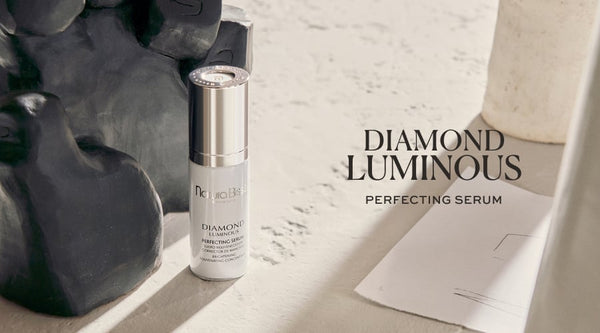
The laws of firmness
The laws of
firmness
We tell you the three principles that you should take into account to improve your skin at different levels
Dermis and epidermis, of quality
A little skin theory
Do you know that, starting at 20 years, natural regeneration of your skin slows down1, leading to the first signs of aging?
On average, the epidermis thins 6.4% every 10 years2

Retinol and bakuchiol
to the rescue!
We enhance retinol with bakuchiol, for greater results and tolerance optimal. Together they promote collagen production 3 4.
· Retinol is a form of vitamin A that stimulates renewal cutaneous5.
· Bakuchiol, of plant origin, extracted from the Psoralea corylifilia plant, has an action similar to that of retinol and multiplies its effects while respecting the skin as much as possible.
· We use retinol encapsulatedto improve its properties and penetration.
Have you heard about retinization?
Retinization is the adaptation phase to retinol that some skin needs when they start using it.If you notice some dryness or peeling, or feel a warm and tingling sensation. It's normal!
These are usually temporary effects, which resolve once the skin gets used to it. Start on alternate nights and with low concentrations, and gradually increase the frequency of use.
Find out how to use Essential Shock Intense Retinol Night Renewal.
If you notice any changes on your skin, space its use and consult your beautician.
The structure of the skin, resistant
A little skin theory
From 25-34 years old we produce between 1 and 1.5% less collagen each year, a loss that accelerates after 406
A boost of
collagen
to “consolidate” your skin
Hydrolyzing is breaking down a molecule into smaller ones through a reaction chemistry.
· Collagen is the most abundant protein in the human body and the framework of your skin.
· Of marine origin, our collagen is hydrolyzed; That is, it is divided into small fragments to improve its absorption.
· By penetrating the skin, it provides a visibly fuller and smoother complexion.
· Combine it with retinol, bakuchiol or Matrixyl, very effective in enhancing its production7.
The skin surface, polished
A little skin theory
So that your skin maintains a optimal thickness, it is necessary harmony between its own renewal and superficial peeling.
Exfoliation yes, but in just the right amount! Doing it in excess can damage the skin barrier.
The chemistry of glycolic acid
With daily gentle exfoliation, the skin activates its own renewal rhythm.
· Of biotechnological origin, this acid dissolves the bonds that hold corneocytes together, facilitating its detachment for a very effective exfoliation.
· Glycolic acid is the alpha-hydroxy acid (AHA) with a weight smaller molecular, so it penetrates the skin better.
· When exfoliating the surface epidermal, reveals new, rejuvenated, smoother, more uniform and luminous.
· The icing on the cake of its effectiveness? It helps the skin generate more collagen and hyaluronic acid8!
The Masters of Firmness
The
Teachers
of Firmness
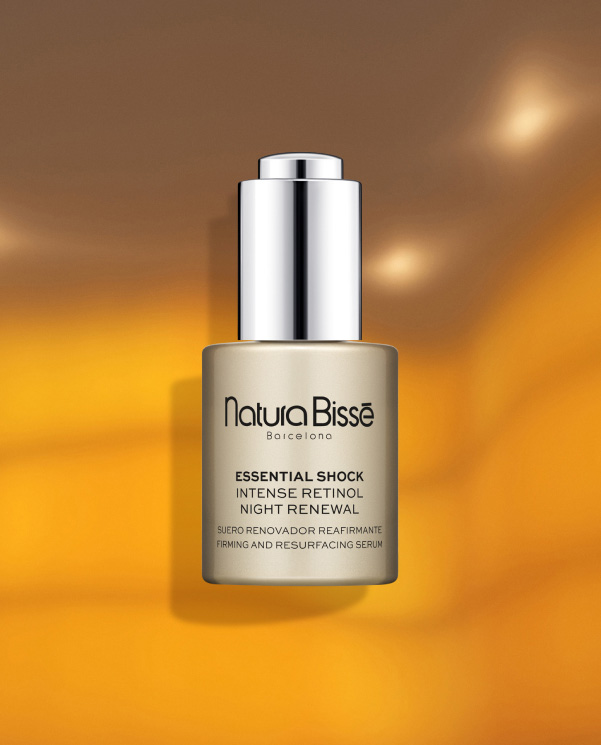
essential shock intense retinol night renewal
Renewing Firming Night Serum
1 fl. oz. / 30ml
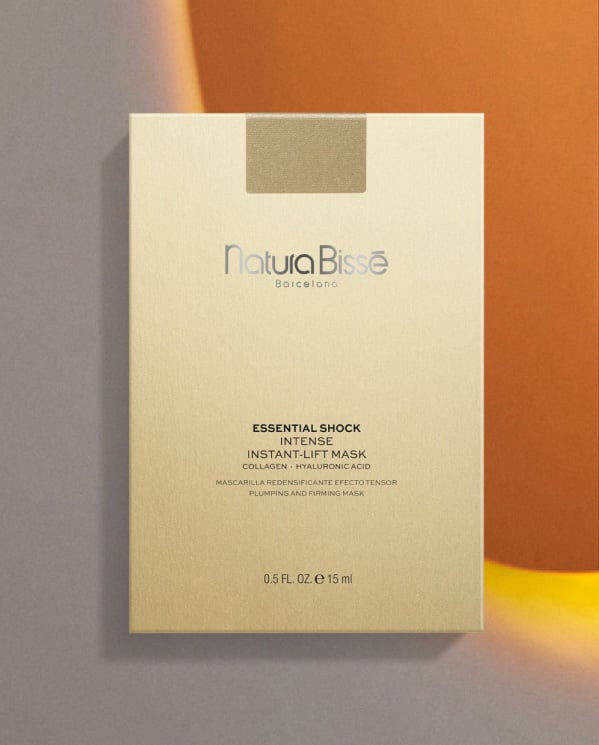
essential shock intense instant lift-mask
Redensifying tightening effect mask
0.5 fl. oz. / 15ml
Sources
(1) G L Grove, A M Kligman:
Age-associated changes in human epidermal cell renewal. Journal of gerontology 38(2), 137–142.
(2) Farage, M. A., Miller, K. W., Elsner, P., & Maibach, H. I. (2013). Characteristics of the Aging Skin. Advances in wound care, 2(1), 5–10.
(3) Chaudhuri, R. K., & Bojanowski, K. (2014). Bakuchiol: a retinol-like functional compound revealed by gene expression profiling and clinically proven to have anti-aging effects. International journal of cosmetic science, 36(3), 221–230.
(4) Zasada, M., & Budzisz, E. (2019). Retinoids: active molecules influencing skin structure formation in cosmetic and dermatological treatments. Postepy dermatologii i allergologii, 36(4), 392–397.
(5) Shao, Y., He, T., Fisher, G. J., Voorhees, J. J., & Quan, T. (2017). Molecular basis of retinol anti-aging properties in naturally aged human skin in vivo. International journal of cosmetic science, 39(1), 56–65.
(6) Reilly DM, Lozano J. (2021). Skin collagen through the lifestages: importance for skin health and beauty. Plastic and Aesthetic Research. 2021; 8:2.
(7) Jones, R. R., Castelletto, V., Connon, C. J., & Hamley, I. W. (2013). Collagen stimulating effect of peptide amphiphile C16-KTTKS on human fibroblasts. Molecular pharmaceutics, 10(3), 1063–1069.
(8) Bernstein, E. F., Lee, J., Brown, D. B., Yu, R., & Van Scott, E. (2001). Glycolic acid treatment increases type I collagen mRNA and hyaluronic acid content of human skin. Dermatologic surgery : official publication for American Society for Dermatologic Surgery [et al.], 27(5), 429–433.